Is Ingrown Toenail Relief Without Surgery Really Possible?
Quick Answer: Yes, in a lot of cases you can treat an ingrown toenail without cutting into it. A nail brace, like the BS Brace, attaches to the nail and gently pulls the edges up and away from the skin, correcting the curve that caused the problem in the first place. It will not replace surgery for every nail, but for many people it ends the pain without touching the nail bed.
Most people assume an ingrown toenail only has one ending: a numbing shot, a scalpel, and a piece of your nail gone for good. That assumption is wrong more often than you'd think.
You've Been Told Surgery Is the Only Fix. It Isn't.
If you've ever limped into a podiatrist's office with a throbbing big toe, you probably heard some version of "we'll need to remove part of the nail." For a lot of patients, that's true. For a lot of others, it's the first option offered, not the only one that works.
The BS Brace flips that script. Instead of removing the part of the nail that's digging into your skin, it corrects the shape of the nail itself. The brace sits on top of the nail plate and applies gentle, continuous tension that lifts the ingrown edges away from the surrounding tissue. No cutting, no local anesthetic, no stitches, no weeks of a bandaged toe.
That's the inversion worth sitting with. Surgery treats the symptom by removing tissue. Bracing treats the cause by changing the nail's growth direction.
What Actually Causes an Ingrown Toenail
An ingrown toenail isn't just "bad luck" from trimming your nails wrong, though that can trigger a flare-up. Underneath most recurring cases is a structural issue: the nail plate itself is curved more than it should be, so as it grows, the edges press into the skin on either side.
Tight shoes, old injuries, and genetics all play a role in that curvature. Once the nail is shaped that way, cutting the ingrown edge off might solve this week's pain, but the nail usually grows back the same way. That's why some people end up back in the same chair a year later asking for the same procedure.
A brace addresses the shape problem directly instead of removing the piece that's currently causing trouble.
How the BS Brace Actually Works
The BS Brace is a thin, flexible device bonded to the surface of the nail. It's built with tension built into the material, so once it's attached, it starts pulling the sides of the nail upward and outward, away from the skin.
Here's the part people find hard to believe until they see it: there's no procedure involved in attaching it. No numbing, no incision. A trained provider cleans and preps the nail, applies the brace, and you walk out the same day with the brace already working.
Over several weeks, as the nail grows, the brace keeps guiding it into a flatter, less curved shape. The nail that grows out from under the brace looks like a normal nail, not a narrower, surgically-altered one.
| Factor | Surgical Nail Extraction | BS Brace |
| --- | --- | --- |
| Procedure | Local anesthetic, partial or full nail removal | No anesthetic, brace bonded to existing nail |
| Downtime | Days to weeks of bandaging and healing | Minimal, usually walk out same day |
| Nail appearance after | Often narrower, altered shape | Natural width and shape preserved |
| Pain during treatment | Post-procedure soreness expected | Generally described as mild to none |
| Best suited for | Severe infection, recurrent failure of conservative care | Mild to moderate curvature, cosmetic concern about nail shape |
The Curvature Is the Problem, Not the Nail Itself
This is the piece most people never hear in a rushed office visit. An ingrown nail isn't defective. It's a nail with too much curve pressing into soft tissue it shouldn't be touching.
Orthonyxia, the clinical term for nail bracing, is built entirely around that idea. Instead of asking "how do we remove the offending part," it asks "how do we reshape the whole nail so nothing is offending anymore." That's a meaningfully different question, and it leads to a meaningfully different outcome for the nail's long-term appearance.
If your goal is to keep your toenail looking like a toenail, that distinction matters.
Who Tends to Choose Which Option, and Why That Matters
Here's a wrinkle worth knowing about before you decide anything. Research on the B/S Brace found a real age gap between the two patient groups: people who had surgical nail extraction had a mean age of 51.2 ± 14.1 years, notably older than the patients treated with the brace (PMC6166465).
That gap doesn't mean bracing stops working once you hit your fifties. What it more likely reflects is how these two groups get selected for treatment in the first place. Younger patients with more flexible nail tissue and less severe or longer-standing curvature tend to be offered conservative options like bracing. Older patients, often after years of recurring ingrown nails or more advanced tissue changes, are more likely to be steered straight to extraction.
That's an honest caveat, not a reason to dismiss the brace. If you're dealing with a nail that's been ingrown once or twice and hasn't caused repeated infections, you're a reasonable candidate for a conservative approach. If you've had the same toe operated on multiple times already, that history matters and deserves a real conversation with a provider about which option fits your situation now.
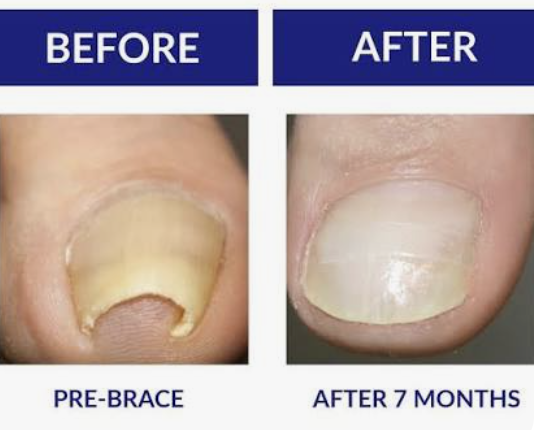
What Before-and-After Nail Correction Actually Looks Like
The most convincing argument for bracing isn't a theory, it's watching the nail change shape over time. Before treatment, the nail plate shows a visible inward curve, often sharp enough that the edges are already pressing into or cutting the skin.
After several weeks under a BS Brace, that same nail plate shows a flatter profile. The edges have lifted away from the skin, and the nail has grown out wider and straighter than it was when treatment started. The cosmetic result is a nail that looks like it was never a problem to begin with, which is exactly what surgical extraction usually can't offer.
That visual difference is the whole case for bracing in one sentence: corrected curvature, preserved nail, no missing tissue.
Is Bracing Right for Your Situation?
Ask yourself a few honest questions before deciding. Has this ingrown nail caused repeated infections, or is this mostly about pain and appearance? Have you already had surgery on this toe before, only to have it grow in the same way?
If you're dealing with a first or second flare-up, without significant infection, bracing is worth discussing before anyone reaches for a scalpel. If you've already been down the surgical road once and the nail came back the same way, correcting the underlying curvature with a brace might finally break that cycle instead of repeating it.
Either way, the decision deserves more than a five-minute consult. It deserves someone looking at your actual nail, not just your symptoms.
- An ingrown toenail is usually caused by excess curvature in the nail plate, not just a bad trim.
- The BS Brace corrects that curvature gradually without cutting, numbing, or removing any part of the nail.
- Surgical extraction patients tend to be older on average (51.2 years) than brace patients, which likely reflects how cases are selected rather than proof that bracing fails for older patients.
- Bracing preserves the nail's natural width and shape, while surgical extraction often changes it permanently.
- Mild to moderate ingrown nails without active infection are the best candidates for a non-surgical approach.
FAQ
Does the BS Brace hurt to apply?
No cutting or anesthetic is involved in applying the brace, so most patients describe the process as uncomfortable at worst, not painful. The brace is bonded directly to the existing nail surface while you're sitting in the chair.
How long does it take to see results from nail bracing?
Results build gradually as the nail grows out under the tension of the brace, typically over several weeks rather than overnight. Your provider can give you a more specific timeline once they've assessed how curved your nail currently is.
Can the BS Brace fix a severely infected ingrown toenail?
Bracing works best on mild to moderate curvature without significant active infection. If your toe is swollen, draining, or clearly infected, that needs direct treatment first, and your provider will tell you honestly if surgery is the better immediate step.
Will my nail look different after treatment with the BS Brace?
The goal of bracing is the opposite of surgical extraction. Instead of narrowing or altering the nail's shape, the brace corrects the curvature while keeping the nail's natural width and appearance intact.
Is orthonyxia the same thing as a toenail brace?
Yes, orthonyxia is the clinical term for the practice of using an external device, like the BS Brace, to correct the shape of a curved or ingrown nail over time rather than removing nail tissue surgically.
Where to Go From Here
Surgery has its place, especially for infected or repeatedly failed nails. But if you're dealing with pain and an ingrown edge for the first or second time, it's worth asking about a brace before you agree to anything that removes part of your nail for good. While you're thinking about foot health more broadly, it's worth reading about how often you should get a pedicure for foot health, not just polish, or looking into how to fix dry, cracked heels if foot discomfort has been a recurring issue for you.